


Journal article
Jean-Baptiste Charlier, Bernard Ladouche, Jean-Christophe Maréchal
Journal of Hydrology, vol. 523, 2015 Apr, pp. 610-623
Journal of Hydrology, vol. 523, 2015 Apr, pp. 610-623
APA
Click to copy
Charlier, J.-B., Ladouche, B., & Maréchal, J.-C. (2015). Identifying the impact of climate and anthropic pressures on karst aquifers using wavelet analysis. Journal of Hydrology, 523, 610–623. https://doi.org/10.1016/j.jhydrol.2015.02.003
Chicago/Turabian
Click to copy
Charlier, Jean-Baptiste, Bernard Ladouche, and Jean-Christophe Maréchal. “Identifying the Impact of Climate and Anthropic Pressures on Karst Aquifers Using Wavelet Analysis.” Journal of Hydrology 523 (April 2015): 610–623.
MLA
Click to copy
Charlier, Jean-Baptiste, et al. “Identifying the Impact of Climate and Anthropic Pressures on Karst Aquifers Using Wavelet Analysis.” Journal of Hydrology, vol. 523, Apr. 2015, pp. 610–23, doi:10.1016/j.jhydrol.2015.02.003.
BibTeX Click to copy
@article{charlier2015a,
  title = {Identifying the impact of climate and anthropic pressures on karst aquifers using wavelet analysis},
  year = {2015},
  month = apr,
  journal = {Journal of Hydrology},
  pages = {610-623},
  volume = {523},
  doi = {10.1016/j.jhydrol.2015.02.003},
  author = {Charlier, Jean-Baptiste and Ladouche, Bernard and Maréchal, Jean-Christophe},
  month_numeric = {4}
}
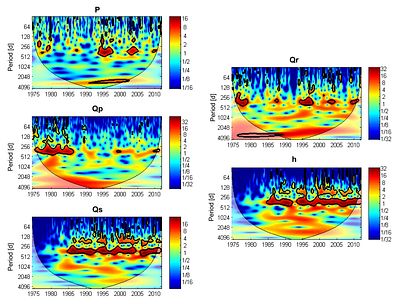
Abstract: This paper assesses the implications of climate and anthropic pressures on short to long-term changes in water resources in a Mediterranean karst using wavelet analysis. This approach was tested on 38-year (1974–2011) hydrogeological time series recorded at the Lez spring (South France), which is exploited for water supply. Firstly, we investigated inter-relationships in the frequency domain by cross-correlation across multiresolution levels. Our results showed that rainfall and spring discharge are highly correlated in the high frequency domain which reflects the hydrogeological response during flood events of typical highly karstified systems. Pumping and groundwater level are correlated in a lower frequency domain, illustrating seasonal to multi-year relationships. Secondly, continuous wavelet transform was applied to characterize the temporal variability of the inter-relationships involved. On the contrary to examples of “non-managed” karst aquifers in the literature, our main results showed that a managed-one does not buffered the high frequencies of the rainfall signal, and reduces that of the lowest frequencies. We assume that the reason why large-scale rainfall component do not appear in the spring discharge is that the hydrogeological response is affected by pumping. This interesting result shows that possible long-term impacts of rainfall variability due to climate evolution may be masked by a high pumping rate. We showed also that despite an increase of the pumping rate from the 1980s, the stress on the groundwater resource does not increase from year to year. The present pumping strategy does not affect the drawdown in the long term, avoiding an over-exploitation of the aquifer. Finally, this study highlights the effectiveness of wavelet analysis in characterizing the response variability of karst systems where the hydrological regime is modified by pumping.
