


Groundwater pumping tests in karst aquifers
Revealing exchanges between conduits and fractured matrix
Revealing exchanges between conduits and fractured matrix
A karst aquifer can be conceptualized as two interacting hydraulic domains:
The hydraulic exchanges between these two domains are driven by differences in hydraulic head. Their relative contributions control the aquifer response to pumping and the evolution of groundwater levels within the system. This response also depends on the location of the pumping well into the heterogeneous aquifer (PWa or PWb on the figure here below).

A long-duration pumping test was conducted in the main karst conduit of the Cent-Fonts system (PWa on figure here below). Pumping was maintained at a constant rate of 400 L/s for approximately one month, resulting in the complete cessation of spring discharge. A double-continuum model was developed to simulate the hydraulic response of the conduit network and the surrounding fractured matrix.

The model reproduced the observed drawdown in the conduit with a relative root mean square error of 2.3%.
The modelling results showed that:
This approach provides a way to quantify exchanges between the two hydraulic domains and improve the interpretation of long-duration pumping tests.

The interpretation of pumping tests in karst aquifers is challenging because the measured hydraulic response results from the successive contributions of different hydraulic compartments.
The diagnostic plot method, based on the logarithmic derivative of drawdown, makes it possible to identify successive flow regimes and relate them to the hydraulic structures involved.
Depending on the aquifer configuration, the diagnostic plots can reveal:
The method provides a framework for interpreting the hydraulic response of complex karst systems beyond conventional homogeneous aquifer models.
The diagnostic plot approach was applied to pumping tests in the Robol well (PWb location), in the Bas-Agly karst system (Corbières, France). The well intersects a small karst conduit at approximately 420 m depth.
The analysis revealed successive hydraulic regimes:
The interpretation was further supported by electrical conductivity measurements. During the test, the conductivity increased sharply, reaching approximately 960 µS/cm, indicating the contribution of more mineralized groundwater from the matrix. It subsequently decreased towards the conductivity of the conduit water (≤750 µS/cm), coinciding with the contribution of another karst volume.
These observations illustrate how hydraulic derivatives and water-quality monitoring can be combined to identify exchanges and hydraulic connections between different karst compartments.

These studies demonstrate that pumping tests can provide much more than estimates of conventional aquifer parameters. When interpreted using appropriate conceptual and analytical approaches, they can help to:
Combining numerical modelling, diagnostic plots and complementary field measurements offers a more comprehensive understanding of groundwater dynamics in karst aquifers.
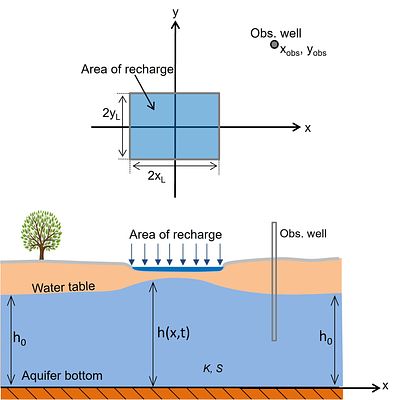
Benoit Dewandel, Sandra Lanini, Vivien Hakoun, Yvan Caballero, Jean-Christophe Maréchal
Hydrogeology Journal, vol. 29, 2021 May, pp. 1009--1026
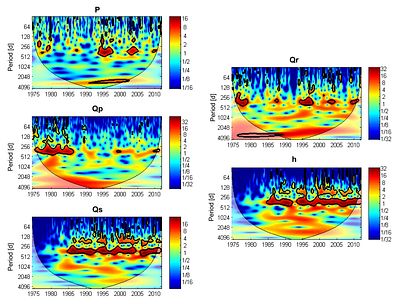
Identifying the impact of climate and anthropic pressures on karst aquifers using wavelet analysis
Jean-Baptiste Charlier, Bernard Ladouche, Jean-Christophe Maréchal
Journal of Hydrology, vol. 523, 2015 Apr, pp. 610-623
Diagnostic Plots Applied to Well-Tests in Karst Systems
Jean-Christophe Maréchal, Bernard Ladouche, Benoît Dewandel, Perrine Fleury, Nathalie Dörfliger
Jacques Mudry, François Zwahlen, Catherine Bertrand, James W. LaMoreaux, H2Karst Research in Limestone Hydrogeology, Springer International Publishing, Cham, 2014, pp. 127--137
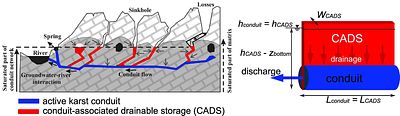
Representation of water abstraction from a karst conduit with numerical discrete-continuum models
Thomas Reimann, Markus Giese, Tobias Geyer, R. Liedl, Jean-Christophe Maréchal, W. B. Shoemaker
Hydrology and Earth System Sciences, vol. 18, 2014, pp. 227--241
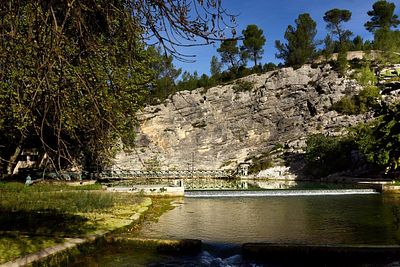
Semi-distributed lumped model of a karst system under active management
Ladouche Bernard, Maréchal Jean-Christophe, Dörfliger Nathalie
Journal of Hydrology, vol. 509, 2014 Feb, pp. 215-230
L’hydrosystème du Lez : une gestion active pour un karst à enjeux
Jean-Christophe Maréchal, Arnaud Vestier, Hervé Jourde, Nathalie Dörfliger
Karstologia, vol. 62, 2013, pp. 1-6
Application de la courbe diagnostique aux essais de pompage en milieu karstique
Jean-Christophe Maréchal, Bernard Ladouche, Benoit Dewandel, Perrine Fleury, Nathalie Dörfliger
Karstologia, vol. 57, 2012, pp. 33-36
Estimating aquifer thickness using multiple pumping tests
Jean-Christophe Maréchal, Jean-Michel Vouillamoz, M S Mohan Kumar, Benoit Dewandel
Hydrogeology Journal, vol. 18, 2010, pp. 1787--1796
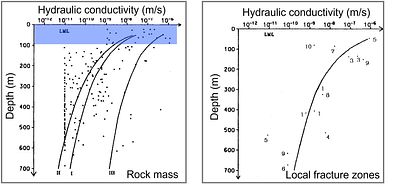
Editor's message: the sunk cost fallacy of deep drilling
Jean-Christophe Maréchal
Hydrogeology Journal, vol. 18, 2010 Mar, pp. 287--289
Interpretation of pumping tests in a mixed flow karst system
Jean-Christophe Maréchal, Bernard Ladouche, Nathalie Dorfliger, Patrick Lachassagne
Water Resources Research, vol. 44, 2008
