


Managed aquifer recharge: percolation tanks in India
MAR in crystalline aquifer under semi-arid conditions
MAR in crystalline aquifer under semi-arid conditions
Percolation tanks are artificial reservoirs widely used across India as a traditional yet effective method for groundwater recharge. Unlike conventional irrigation tanks that store water for direct use, percolation tanks are designed to capture monsoon runoff and allow it to gradually seep into the soil, replenishing underground aquifers.
These structures play a critical role in water-scarce regions of India, particularly in states like Maharashtra, Karnataka, Andhra Pradesh, and Madhya Pradesh. By facilitating natural infiltration, they help mitigate drought conditions, support agricultural activities, and contribute to soil conservation and ecological balance. Studies have shown that percolation tanks have significantly enhanced groundwater availability over decades, making them an essential component of India's rainwater harvesting and water management strategies. Small tanks (under 40 hectares) have increasingly been converted into percolation tanks as part of managed aquifer recharge (MAR) initiatives.
Gajwel
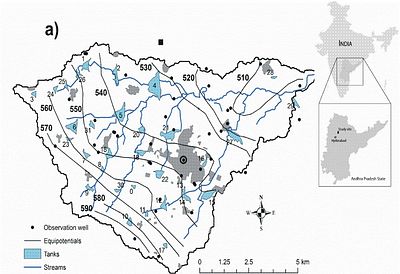
31 tanks - total: 2,77 km2
Efficiency: 19 - 35 %
Perrin et al. 2012
Our studies reveal that infiltration rates in percolation tanks built on crystalline rock are relatively low, with evaporation rates sometimes approaching infiltration levels, as observed at the Tumulur basin (Efficiency = 56%) in Maheshwaram watershed.
In the Choutuppal basin, infiltration rates were initially higher (95% at the start) due to feeding from the Musi River, which brought large water volumes (up to 3m water depth). However, monitoring showed a rapid decline in infiltration efficiency over time: rates dropped from 250 mm/day during initial filling phases to less than 150 mm/day thereafter. The proportionality coefficient linking infiltration rate to water height decreased significantly after 80 days, as suspended materials from the Musi River quickly clogged the tank bottom.
Similarly, Gajwel basins exhibited very low infiltration rates, with evaporation accounting for up to 35% of harvested water.
Given that the state contains over 200,000 such tanks, this raises critical questions about their maintenance and actual role in the regional hydrological balance. The fundamental question remains: are these truly infiltration tanks, or merely evaporation tanks?
(Efficiency is defined as the ratio between infiltration and total amount of water inflow)
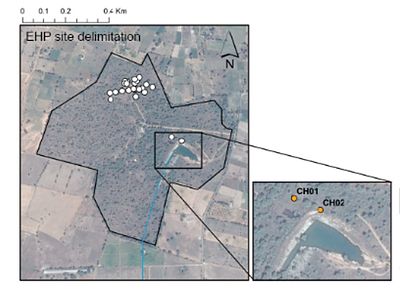
Madeleine Nicolas, Olivier Bour, Adrien Selles, Benoit Dewandel, Vincent Bailly-Comte, Subash Chandra, Shakeel Ahmed, Jean-Christophe Maréchal
Journal of Hydrology, vol. 573, 2019 Jun, pp. 717--732
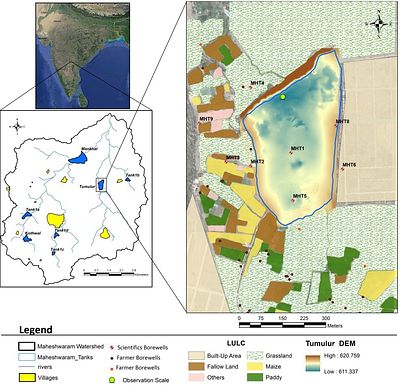
M. Alazard, A. Boisson, Jean-Christophe Maréchal, J. Perrin, B. Dewandel, T. Schwarz, M. Pettenati, G. Picot-Colbeaux, W. Kloppman, S. Ahmed
Hydrogeology Journal, vol. 24, 2016 Feb, pp. 35--57
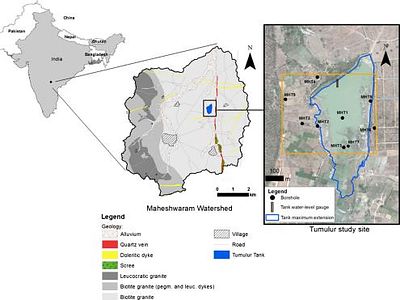
Alexandre Boisson, David Villesseche, Mathieu Baisset, Jérome Perrin, Matthieru Viossanges, W. Kloppmann, Shandra Chandra, Benoit Dewandel, G. Picot-Colbeaux, R. Rangarajan, Jean-Christophe Maréchal, Shakeel Ahmed
Environmental Earth Sciences, vol. 73, 2015 Jun, pp. 7711--7721
Jérôme Perrin, Sylvain Ferrant, Sylvain Massuel, Benoit Dewandel, Jean-Christophe Maréchal, Stéphanie Aulong, Shakeel Ahmed
Journal of Hydrology, vol. 460, 2012 Aug, pp. 143--155

