

Piece 2 - Hydrodynamic properties
How does water actually move through the fractured layer?
How does water actually move through the fractured layer?

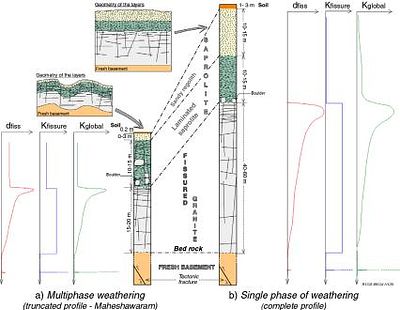
A fractured aquifer is not simply a porous medium with a few fractures.
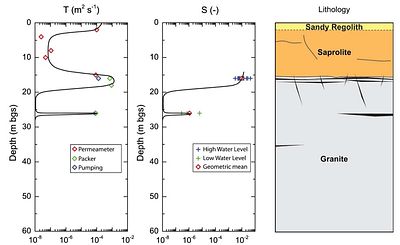
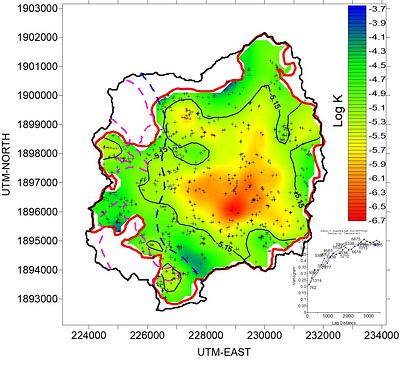
At Maheshwaram, hydraulic tests at different scales were used to characterize the fractured-weathered layer. Slug tests, injection tests and pumping tests were interpreted using analytical approaches including double-porosity, anisotropic and fractional-flow models.
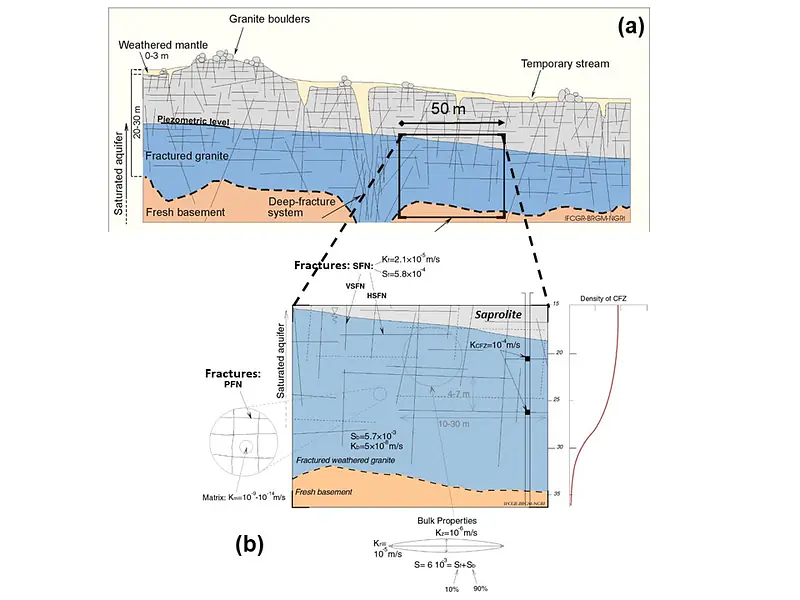
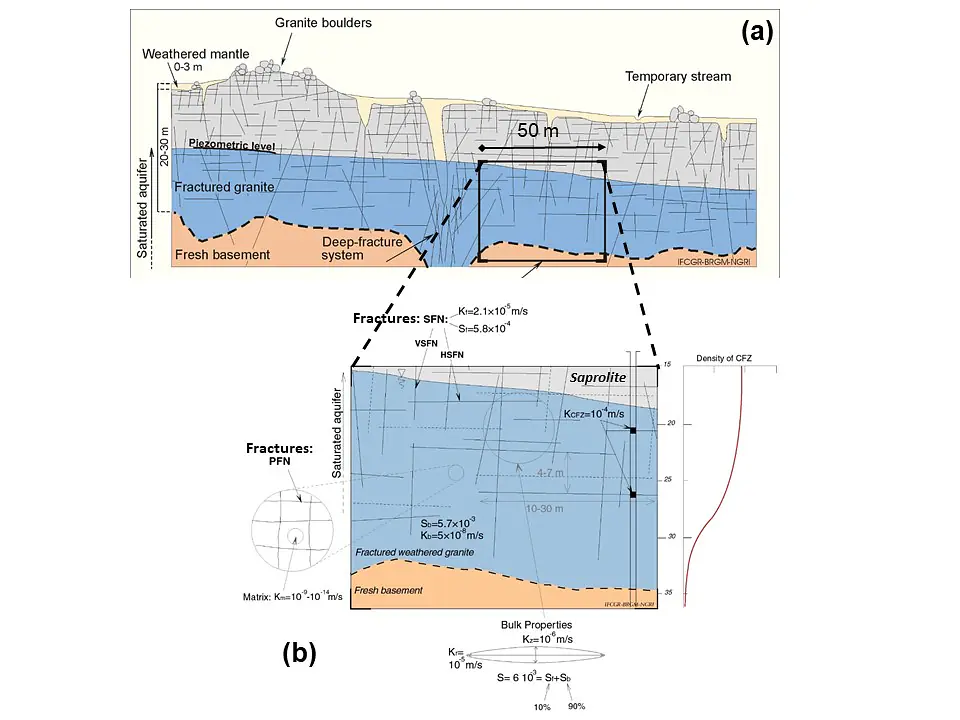
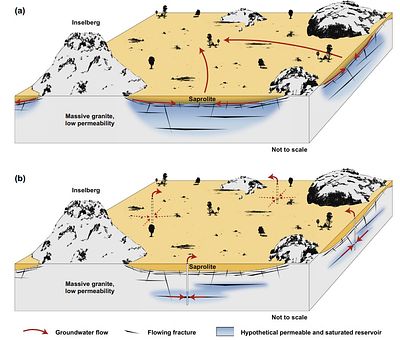
Fractures control transmissivity, while smaller-scale fracture networks contribute substantially to groundwater storage.
Jean-Christophe Maréchal, Adrien Selles, Benoit Dewandel, Alexandre Boisson, Jerome Perrin, Shakeel Ahmed
Vadose Zone Journal, vol. 17, 2018 Nov
Alexandre Boisson, Nicolas Guihéneuf, Jérôme Perrin, Olivier Bour, Benoit Dewandel, Amélie Dausse, Mathieu Viossanges, Shakeel Ahmed, Jean-Christophe Maréchal
Hydrogeology Journal, vol. 23, 2015 Jun, pp. 757--773
Nicolas Guihéneuf, Alexandre Boisson, Olivier Bour, Benoit Dewandel, Jerome Perrin, A.mélie Dausse, Matthieu Viossanges, Shandra Chandra, Shakeel Ahmed, Jean-Christophe Maréchal
Journal of Hydrology, vol. 511, 2014, pp. 320-334
Benoit Dewandel, Jean-Christophe Maréchal Maréchal, Olivier Bour, Bernard Ladouche, Shakeel Ahmed, Subash Chandra, Hélène Pauwels
Journal of Hydrology, 416-417, 2012, pp. 83-97
Estimating aquifer thickness using multiple pumping tests
Jean-Christophe Maréchal, Jean-Michel Vouillamoz, M S Mohan Kumar, Benoit Dewandel
Hydrogeology Journal, vol. 18, 2010, pp. 1787--1796
Benoit Dewandel, Patrick Lachassagne, Robert Wyns, Jean-Christophe Maréchal, N.S. S. Krishnamurthy
Journal of Hydrology, vol. 330, 2006 Oct, pp. 260--284
Jean-Christophe Maréchal, Robert Wyns, Patrick Lachassagne, K Subrahmanyam
Journal of the Geological Society of India, vol. 63, 2004, pp. 545--550
Jean-Christophe Maréchal, Benoit Dewandel, K Subrahmanyam
Water Resources Research, vol. 40, 2004 Nov
Jean-Christophe Maréchal, Robert Wyns, Patrick Lachassagne, K Subrahmanyam, Frédéric Touchard
Comptes Rendus Geoscience, vol. 335, 2003, pp. 451--460
