

Fractured crystalline aquifers
Hydrodynamic properties and groundwater budget
Hydrodynamic properties and groundwater budget
The hydrodynamic properties of the weathered-fractured layer of a hard-rock pilot watershed in a granitic terrain are characterized using hydraulic tests at different scales.
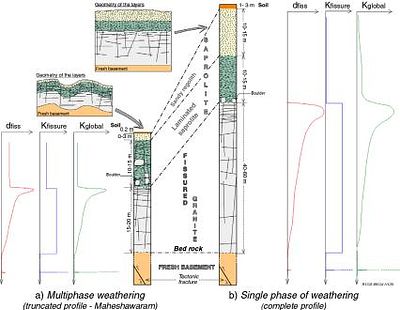
Deep drilling of borewells to hundreds of meters – depth is increasingly frequent for water exploration in fractured crystalline rocks. At the same time, many studies provide evidence that hard-rocks areas are characterized by a shallow higher-permeability zone (‘‘active’’ zone) that overlies a deeper lower-permeability zone hosting little flow (‘‘inactive’’ zone). Consequently, the yields of borewells decrease dramatically with depth. This gap between hydrogeological practice and science can be explained by a well-known behaviour in psychological sciences. The escalation of commitment consists in justifying increased investment in a decision, based on the cumulative prior investment, despite new evidence suggesting that the decision was probably wrong. This behaviour leads to the sunk cost fallacy of deep drilling: drilling a borehole to unreasonable depth in the hope of recovering the money wasted to drill the first dry meters. As water experts, we should contribute to end this irrational trend of wells deepening in hard-rocks.
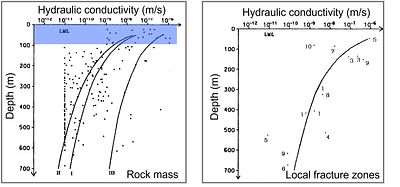
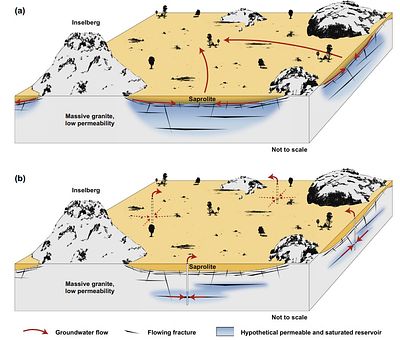
We investigate the hydrodynamic properties of the weathered and fractured layer of a granitic hard-rock watershed using hydraulic tests at different scales. The results show that the most conductive part of the aquifer is mainly limited to the upper 35 meters, with approximately 90% of the drainage porosity stored in rock blocks and 10% associated with fractures. Two fracture networks were identified: a primary network that enhances the permeability and storage capacity of the rock matrix, and a secondary network composed mainly of conductive horizontal fractures and less permeable sub-vertical fractures that ensure aquifer connectivity. Overall, the study demonstrates that a continuous and laterally homogeneous weathering process is largely responsible for the development of fractures and controls the hydrodynamic properties of shallow hard-rock aquifers.
Pumping tests carried out in the fissured layer of a granitic hard-rock aquifer, interpreted at the observation wells by means of the analytical solution of Neuman and at the pumping wells with that of Gringarten show the existence of a strong vertical anisotropy of this layer of the aquifer; the horizontal permeability is higher than the vertical permeability. These results agree perfectly with the geological observations, the fissured layer of the weathered granite profile showing the existence of many sub-horizontal fissures. It confirms that, within the fissured layer, the permeability of sub-horizontal fissures due to the weathering process dominates over that of sub-vertical fissures of tectonic origin.
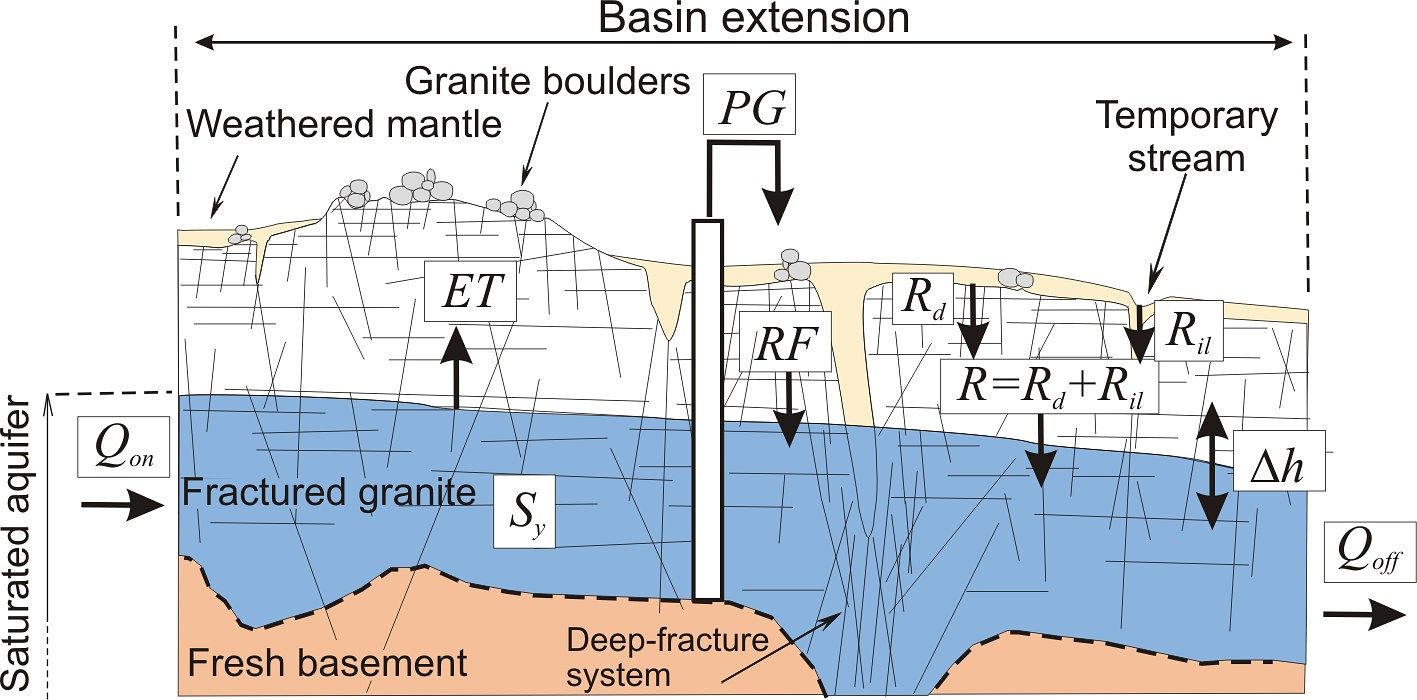
A water budget approach is developed to jointly estimate specific yield and natural recharge in an unconfined aquifer with significant seasonal water table fluctuations. Water table fluctuations are due to distinct seasonality in groundwater recharge. The separation of the hydrologic year into two (or more) extended seasons of recharge (wet season) and no-recharge (dry season) with accompanying changes in water table allows for a split use of the water table fluctuation (WTF) method, first to estimate specific yield from the water table drop during the dry season (no recharge) and, second, to estimate recharge from the water table rise during the wet season, after considering all other water budget components explicitly. The latter includes explicit computation of groundwater storage with the WTF method. The application of the WTF method requires a large number of water level measurements throughout the unconfined aquifer before and after each season. The advantage of the method is that specific yield and recharge are estimated at the scale of interest to basin hydrologic studies and that the method requires no extensive in situ instrumentation network. Here, the method is demonstrated through a case study in a fractured hard-rock aquifer subject to intensive groundwater pumping for irrigation purposes.
Jean-Christophe Marechal, Adrien Selles, Benoit Dewandel, Alexandre Boisson, Jerome Perrin, Shakeel Ahmed
Vadose Zone Journal, vol. 17, 2018 Nov
N. Guihéneuf, A. Boisson, O. Bour, B. Dewandel, J. Perrin, A. Dausse, M. Viossanges, S. Chandra, S. Ahmed, J.C. Maréchal
Journal of Hydrology, vol. 511, 2014, pp. 320-334
Estimating aquifer thickness using multiple pumping tests
Jean-Christophe Maréchal, Jean-Michel Vouillamoz, M S Mohan Kumar, Benoit Dewandel
Hydrogeology Journal, vol. 18, 2010, pp. 1787--1796
Benoit Dewandel, Patrick Lachassagne, Robert Wyns, Jean-Christophe Maréchal, N.S. S. Krishnamurthy
Journal of Hydrology, vol. 330, 2006 Oct, pp. 260--284
Jean-Christophe Maréchal, Robert Wyns, Patrick Lachassagne, K Subrahmanyam
Journal of the Geological Society of India, vol. 63, 2004, pp. 545--550
J C Marechal, B Dewandel, K Subrahmanyam
Water Resources Research, vol. 40, 2004 Nov
Jean-Christophe Maréchal, Robert Wyns, Patrick Lachassagne, K Subrahmanyam, Frédéric Touchard
Comptes Rendus Geoscience, vol. 335, 2003, pp. 451--460
