


Fault rock aquifer functioning
Basement context (French Brittany)
Basement context (French Brittany)
Groundwater flow in crystalline rocks is largely controlled by the organization and connectivity of fractures and faults within a relatively impermeable rock matrix. These structures form complex aquifer systems in which groundwater can originate from different reservoirs and have contrasting residence times and geochemical signatures.
This study investigates the Saint-Brice-en-Coglès experimental site in Brittany, France, where a highly permeable, subvertical fault zone constitutes the main drainage structure of a crystalline aquifer.
A comprehensive geochemical investigation was conducted under natural conditions and during a nine-week pumping test. Major and trace elements, dissolved gases, groundwater dating tracers (CFCs and SF₆), noble gases and stable isotopes were combined with multivariate statistical analysis and end-member mixing analysis (EMMA).
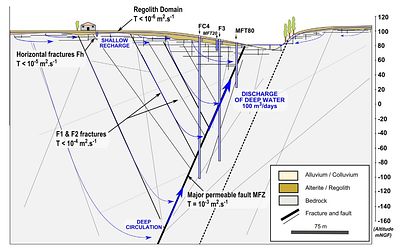
1. Groundwater sources vary with hydrological conditions. During low-water periods, groundwater consists of a mixture of recent water and older water, probably originating from storage in low-permeability bedrock compartments. During high-water periods, modern water infiltrates deeper into the fractured bedrock.
2. Significant hydraulic exchanges occur between the fault zone and surrounding aquifer compartments. Pumping reveals hydraulic connections between the highly permeable fault zone, the weathered regolith and the surrounding fractured domains. These compartments contribute substantially to well discharge, with their relative contributions changing over the course of pumping.
3. Groundwater mixing triggers geochemical reactions within the aquifer. Pumping induces mixing between waters of different chemical compositions and highlights autotrophic denitrification associated with the oxidation of pyrite and other iron-bearing minerals. Nitrate consumption during the pumping test was estimated at approximately 280 kg.

Groundwater sources and geochemical processes in a crystalline fault aquifer
Clément Roques, Luc Aquilina, Olivier Bour, Jean-Christophe Maréchal, Benoît Dewandel, Hélène Pauwels, Thierry Labasque, Virginie Vergnaud-Ayraud, Rebecca Hochreutener
Journal of Hydrology, vol. 519, 2014, pp. 3110-3128
