Fractured crystalline-rock aquifers
How does water circulate through crystalline-rock aquifers?
How does water circulate through crystalline-rock aquifers?
1. Weathering-related porosity and permeability
Weathering transforms crystalline rocks into a heterogeneous profile consisting of a weathered mantle (saprolite) overlying a fractured bedrock horizon. The saprolite generally provides substantial storage through intergranular porosity, whereas the underlying fractured horizon often provides the main pathways for groundwater flow. Together, these layers form the characteristic weathered basement aquifer system.
Weathered-fractured layers in basement context (India, Africa)

2. Structurally controlled permeability: fault aquifer
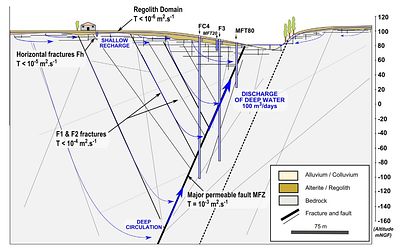
Faults, tectonic fractures and shear zones can create preferential groundwater flow paths within otherwise low-permeability crystalline rocks. Their hydraulic properties depend on fracture aperture, connectivity, orientation and infilling. These zones may conduct groundwater over considerable distances and drain adjacent rock, but they can also act as hydraulic barriers. Their permeability may reflect tectonic deformation, subsequent reactivation, weathering, or a combination of these processes. They can deeply extend below the shallow weathering profile, groundwater circulation persisting within these deep fractures extending into relatively fresh crystalline bedrock.