
Banner image placeholder
Banner image

Piece 4 - Groundwater–Surface Water Interactions


Is the river feeding the aquifer — or the aquifer feeding the river?


How do groundwater and surface water interact in fractured crystalline aquifers under highly seasonal and semi-arid conditions?

How do these exchanges control groundwater recharge, storage and streamflow, and how are they influenced by weathering, fractures and episodic rainfall?

Back to the crystalline puzzle

Key findings

  • Groundwater–surface water exchanges are dynamic and bidirectional, controlled by hydraulic gradients, geological structures and hydrological conditions. Groundwater can sustain streamflow, while surface water can contribute significantly to groundwater recharge when hydraulic conditions favour infiltration.
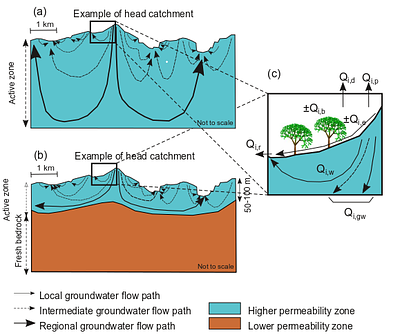
  • Groundwater circulation strongly controls the transfer of weathering products from soils and rocks to surface waters, influencing dissolved-element fluxes. Natural chemical tracers can reveal contrasting groundwater flow paths and quantify groundwater contributions to headwater streams.
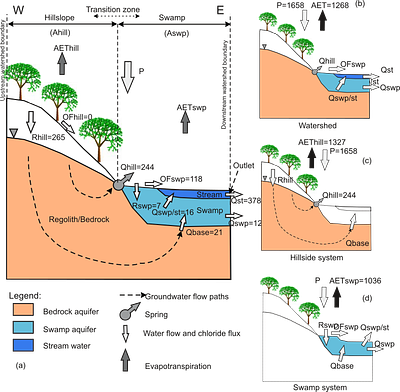
  • Wetlands and headwater swamps can regulate groundwater–stream exchanges, modulating both water fluxes and chemical export.

Key publications


Deep groundwater flow as the main pathway for chemical outputs in a small headwater watershed (Mule Hole, South India)


Jean-Christophe Maréchal, Jean Riotte, Christelle Lagane, S. Subramanian, C. Kumar, Laurent Ruiz, Stéphane Audry, M.R.R. Varma, Jean-Jacques Braun

Applied Geochemistry, vol. 26, 2011, pp. S94-S96


Hydrological processes of a rainforest headwater swamp from natural chemical tracing in Nsimi watershed, Cameroon


Jean-Christophe Maréchal, Jean-Jacques Braun, Jean Riotte, Jean-Pierre Bedimo Bedimo, Jean-Loup Boeglin

Hydrological Processes, vol. 25, 2011, pp. 2246-2260

Share

Text Only Owlstown
QR Code
Translate to