


Piece 1 - The active zone
Where is the aquifer?
Where is the aquifer?

How deep does a basement aquifer really extend?
Crystalline-rock aquifers are not uniformly permeable with depth. Field observations show that groundwater circulation is concentrated within a relatively shallow hydrogeologically active zone, where fractures are more abundant and hydraulically conductive.
Investigations at the Maheshwaram and Maddur experimental sites in southern India showed that fracture density and hydraulic productivity decrease markedly with depth. At Maheshwaram, most hydraulically active structures occur within the upper 30 m, while fracture density becomes very low below about 40 m.
1. A shallow active zone controls groundwater circulation. Most productive fractures occur within the upper part of the weathered/fractured profile.
2. The upper fractured zone is particularly conductive. At Maheshwaram, the uppermost part of the fractured layer contains a high density of hydraulically conductive fractures.
3. Pumping tests can help determine the aquifer thickness. Multiple pumping tests developed at Maddur provided an estimate of the hydraulic bottom of the aquifer at about 27 m, consistent with geophysical observations.
4. The geological history controls aquifer geometry. The weathering profile can result from several successive phases of weathering and erosion. At Maheshwaram, this produced a stratified profile consisting of regolith, laminated saprolite and a fractured layer.
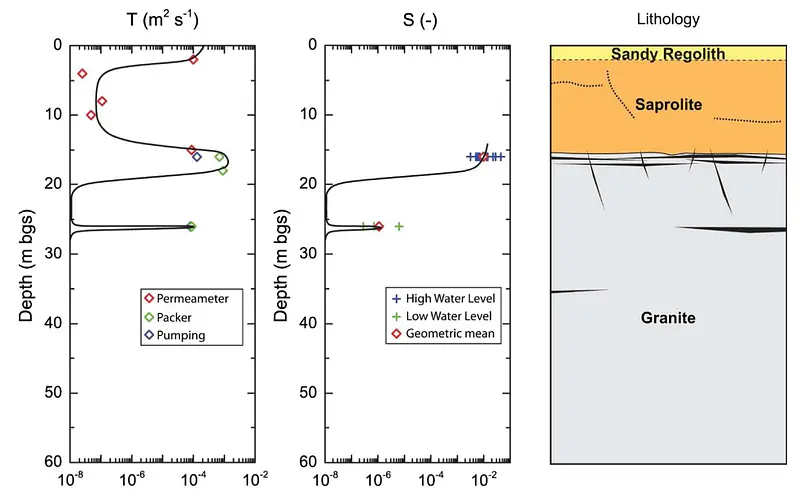
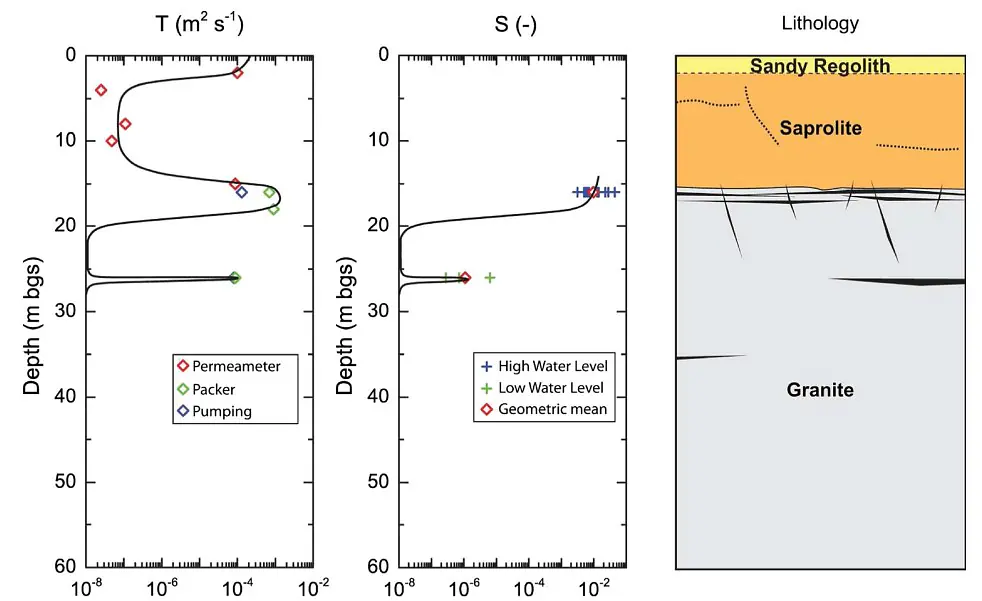
The transmissive part of a basement aquifer is generally concentrated within a shallow, highly fractured zone rather than extending uniformly to great depths.
Alexandre Boisson, Nicolas Guihéneuf, Jérôme Perrin, Olivier Bour, Benoit Dewandel, Amélie Dausse, Mathieu Viossanges, Shakeel Ahmed, Jean-Christophe Maréchal
Hydrogeology Journal, vol. 23, 2015 Jun, pp. 757--773
Estimating aquifer thickness using multiple pumping tests
Jean-Christophe Maréchal, Jean-Michel Vouillamoz, M S Mohan Kumar, Benoit Dewandel
Hydrogeology Journal, vol. 18, 2010, pp. 1787--1796
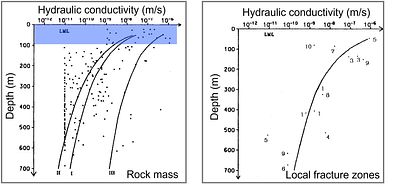
Editor's message: the sunk cost fallacy of deep drilling
Jean-Christophe Maréchal
Hydrogeology Journal, vol. 18, 2010 Mar, pp. 287--289
